Saturday, 22 February 2014

Tatyana Fazlalizadeh

"Street harassment is a serious issue that affects women world wide. This project takes women’s voices, and faces, and puts them in the street - creating a bold presence for women in an environment where they are so often made to feel uncomfortable and unsafe"
This is Tatyana's artistic statement, she is traditionally an oil painter but turned to street paste ups as a way to get her ideas out there and interacting with more people.  The statements she uses below her drawings are taken from real lines she has been faced with and inspiration from other women's experiences. I think this is really important for communicating her message as some men will recognise the lines in her work as pick up lines they themselves used. By using their words but presenting them in a different light she forces them to look at their own behaviour from a distance. I think this is what makes her work powerful 


Her work is almost like an education on the go for narrowed minded men, and this is my favourite lesson, "Women do not owe you their time or conversation.' So often it is thought women owe men, either owe them a kiss after drinks, or owe them their politeness. But this is instilled into our society that women are indebted to men, but it is not true, women do not owe men anything. This poster works so well because it expresses this defiance of norm in our society as the woman stares boldly out, making the viewer question their own beliefs.


The styles of font she has used are interesting because they contrast so markedly with both her illustration style and the graffiti behind. The font is very delicate and clear to read but has a strength to it which empowers her message.

The drawing style is really interesting, as there is a lot of detail around the eyes and facial features. This really communicates the idea of seeing these women as humans, not just a pair or boobs or great ass, and I think this is why the clothing is not detailed to emphasise that it should not matter what the woman is wearing, she should always be treated with respect. The dark tones around the face make the women seem very powerful and intimidating. I think it would be really striking to see one of these on the street, turning the corner and meeting their eyes. So often women avoid eye contact on the streets this direct eye contact would be markedly striking to both male and female viewer.


"I've generally gotten negative feedback from men who don't understand and don't find street harassment to be a serious issue." I think this is really interesting, it seems to be a recurring theme in my research that men are unaware of street harassment and the effect it can have on women's mind.


The incredible Laci Green- Followed by youtube comments that will make you cry


"I'm not a person to this guy, I'm not a human being who is giving a clear back off signal, no I was a cute thing, an object for him to look at, poke and prod at for his own pleasure."
This is the problem many men do not see the problem with treating women like this, this is because our society through adverts and media completely support and proliferate this attitude. 
I think Laci Green is pretty fantastic because she really shows just how ludicrous the differences in gender are. Her youtube channel is a really positive force as she is generating discussion on issues in sex and relationships which are often brushed over in sexual education. I really admire her work because she really gives a platform to discuss issues that people might not be comfortable talking to their friends and family about but that doesn't mean that they shouldn't be talked about. 


Can you actually believe people like this exist? And unfortunately I did not have to scroll for a long time to collect these, probably about 5 minutes. From very rude to very disgusting, it is shocking the views that some people have and how when they attack Laci Green they do it by attacking her personal appearance. This is pretty savage but is the status quo, often when women are criticised their appearance is needlessly bought into it. Is it even to communicate to these people how damaging sexual objectification is to both women and men?

Sex Dolls- Prepare to be disgusted

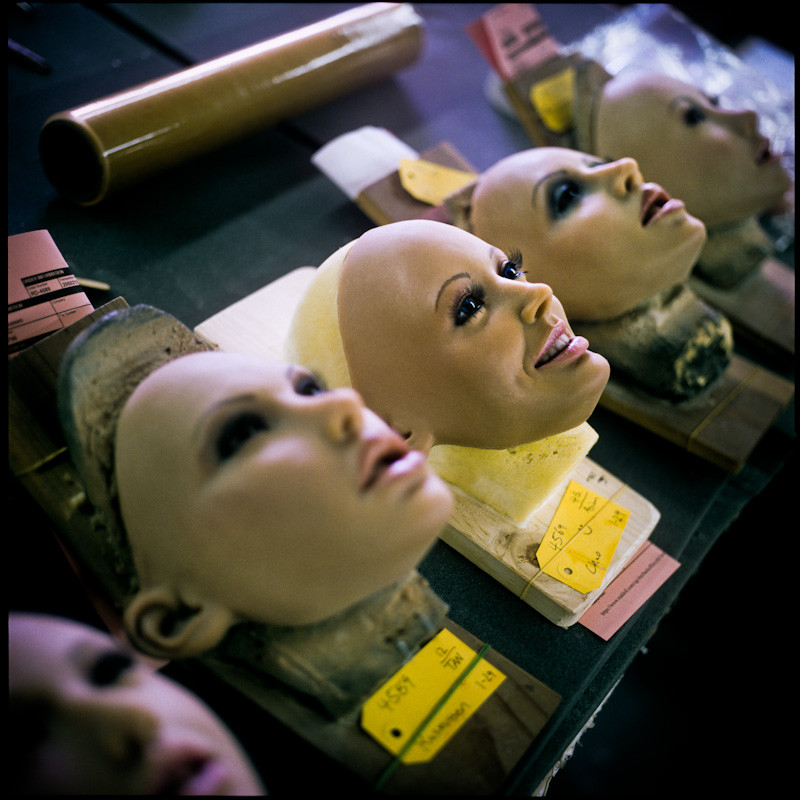
A Peek At A Sex Doll Factory: What Happens Before They Become 'Companions'


Along with empty changing rooms, multi-storey car parks and ghoulish tourist sites where mass killings have taken place, the next eeriest place must be the factories where sex dolls are made.

For many men who use sex dolls, they aren't just dolls, rather 'companions' who replace real women in their lives. Some men, such as 60-year-old Bob Givens who has the world's largest collections of dolls and appeared on This Morning, are married.
sex dolls
The insight into what goes on behind the scenes at the factory is frankly, eerie.
Disembodied heads, smiling plastic faces, rows and rows of teeth - it's almost a true reflection of the seedy fate that awaits them.
The photos are part of photographer Zackary Canepari's project Love Machines, which was shot at a Californian factory in San Marcos called Abyss Creations. Each of the dolls cost around $7,000 (£4,500) and are customised.
Haunting, aren't they? The photos were taken for a film called Honey Pie, directed by Zackary and Drea Cooper. It is part of a documentary film series called California Is A Place.
In the film, Zackary and Drea interview sculptor Matt McCullen, who explains the reasoning behind one Alaskan customer who had ordered the doll and had no companionship.
"They had to bring this doll out in this large, coffin-like box," he says in the video. "But he loved it. He said it really took away the edge off of his loneliness and being alone out there."
dolls
The sculptor said he was always driven to sculpt females. "I had to test them and make a vagina in a box...and I had to try it out. I took it very seriously. I graciously donated myself to making sure everything worked right."
The photos accomplish something that words possibly couldn't - the world of sex dolls strips women down to their minute parts, and listening to a man describe 'testing' a vagina reduces women to the barest components. It has nothing to do with love, as far as we can see.

I find it hard not to be sick when looking at these images, like some perverse Barbie shop of horrors this  is definitely at the furthest edge of the sexual objectification spectrum. When I have been doing my research people have been defining S.O as reducing women to a pile of sexual parts and this is exactly what these sex dolls represent. The photos are just terrifying, it does make you question what sort of men would buy these dolls and what sort of society do we live in where men can buy life-size dolls. Just the fact that they have to be transported in a coffin like box shows how perverted and horrible it is. Sex dolls are the embodiment of sexual objectification, completely passive, silent, and supposedly sexy not sexual. It disgusts me that these are made as there is obviously a market for them, showing some men want this embodiment of sexual objectification. In some ways it makes me sad that we live in a society that has raised men like this that feel like they need to buy these to satisfy their warped desires.
These dolls are almost an extension of the porn industry, selling something which is unrealistic and completely male viewer orientated. 


x

The Objectification of Women - It Goes Much Further Than Sexy Pictures

When feminists decry the objectification of women, most people immediately think of the images that saturate our magazines, movies, adverts and the Internet, of women in varying stages of undress, dolled up and presented for the male gaze. Yet, while sexual objectification is a huge problem, it is, sadly, only a fraction of the objectification of women that permeates our world, from the moment we enter it.
Because it is all too obvious and difficult to ignore, we tend to focus on sexual objectification. The difference between the way women and men are portrayed in national newspapers and other media is stark - women are too often reduced to the sum of their body parts, heavily Photoshopped to fit into an ever narrowing ideal of female beauty. It grabs our attention, we recognize that something isn't right, and we confidently assert that this is sexism in action.
And we're right, of course. Yet, an overemphasis on the 'sexual' aspect can obscure the much more problematic aspect of 'objectification', the iceberg of which sexual objectification is the visible tip. After all, being presented in a sexual way doesn't always mean objectification. Sexy pictures of men, in contrast to sexy pictures of women, frequently portray them as sexual subjects, actors exercising their sexuality, instead of objects meant to gratify someone else's sexuality.
So, what do I mean when I say that sexual objectification is simply the most visible part of objectification? Well, let's start by differentiating between subject status and object status. While a subject is active, with agency, an object is passive, being acted upon. This dichotomy is reflected in our grammar; when we hear, "Fiona stroked the cat," we recognize that 'Fiona' has subject status, while 'the cat' has object status. Now in an ideal world, we would find ourselves randomly cast as either subject or object at different times, depending on the situation, with no problems. However, in society's dominant narrative, subject and object status is heavily gendered, with men granted subject status the vast majority of the time, and women severely objectified.
These messages start right from the cradle. A study by Janice McCabe showed that male characters in children's books far outnumber female ones, and that even when characters (eg. animals) are gender-neutral, they are often referred to as male when parents read them to their kids. This pattern is consistent in children's TV shows, where only a third of lead characters are girls. The Smurfette Principle, where only one female character is present in an entire cast of male ones, still holds true for many TV shows, with 'female' seemingly a characteristic of its own.
Having been brought up on a diet of stories revolving around boys and men, this male-centeredness continues to dog us throughout our lives. The vast majority of films produced tell the stories of men, with women cast as girlfriends, wives, or mothers, or in other periphery roles. In a typical year, only about 12-15% of top grossing Hollywood films are women-centric, focusing on women and their stories.
It isn't just the media that does this. In everyday conversation, male pronouns dominate our speech and ideas. Every dog we see is a 'he', every stick figure a 'he', humans thought of as simply 'mankind'. There are exceptions, though. Boats, cars, bikes and ships always seem to be 'she', but this is hardly exciting once we realise that they are all objects, and possessions of (usually) men, at that.
Anyway, the cumulative effect of all this is that we are socialising generation after generation to view the world, and the women in it, from the point of view of men. As a result, only men are seen as full and complete human beings, not women. Women are objectified - this means we are denied agency, and are seen from the outside, our own consciousness, our thoughts and feelings, utterly overlooked.
It is because society tells us that women are objects, not subjects, that Tomb Raider's executive producer, Rob Rosenberg, finds it natural to assert that players "don't project themselves into [Lara Croft's] character," that they think "I'm going to this adventure with her and trying to protect her." Even though they are actually playing as Lara.
It is because society tells us that women are objects, not subjects, that Stephen Hawking can declare women to be "a complete mystery", and have newspapers gleefully latch on to this, declaring women "the greatest mystery known to man". It is a common refrain for men to bleat about not understanding women, but this is because they have simply never tried, because society has trained them to never look at life through the eyes of a woman.
It is because society tells us that women are objects, not subjects, that when society is presented with a case of male violence or sexual abuse, everyone looks at it from his point of view: "Oh, he must have been provoked to have done that," "He was a nice man who just snapped," "He must have been confused by her signals," "Maybe he's been falsely accused, how terrible to have to go to jail for that." With every victim-blaming, rape / violence apologist comment, society reveals through whose eyes it looks, and the answer is invariably the man's.
It is because society tells us that women are objects, not subjects, that even good men, when speaking out against violence against women, tell other men to imagine her as "somebody's wife, somebody's mother, somebody's daughter, or somebody's sister," it never occurring to them that maybe, just maybe, a woman is also "somebody".
It is frightening to consider just how deeply entrenched objectification of women really goes. We must certainly combat sexual objectification, but the battle will not end there. Women are objectified in more profound ways than we realise, and we must tear down every entwined shred of the patriarchy, in order to achieve our modest goal of being recognized and treated as human beings.

I really like her emphasis on the objectification and not the sexual part, as the crux of the problem is that women are seen as passive objects that are incapable of acting, only being acted upon. As this damages women's ideas about what they can achieve and limits their ambitions. 

 It is a common refrain for men to bleat about not understanding women, but this is because they have simply never tried, because society has trained them to never look at life through the eyes of a woman.
This is the most important line, as I had not thought about it this way before, men are never taught to even think about a women's perspective because they are surrounded by the idea that it is the male mind that is of more importance.

Male Gaze

FAQ: What is the “male gaze”?

The Male GazeBefore talking about the male gaze, it is first important to introduce its parent concept: the gaze. According to Wikipediathe gaze is a concept used for “analysing visual culture… that deals with how an audience views the people presented.” The types of gaze are primarily categorized by who is doing the looking.
While the ideas behind the concept were present in earlier uses of the gaze, the introduction of the term “the male gaze” can be traced back to Laura Mulvey and her essay “Visual Pleasure and Narrative Cinema” which was published in 1975. In it, Mulvey states that in film women are typically the objects, rather than the possessors, of gaze because the control of the camera (and thus the gaze) comes from factors such as the as the assumption of heterosexual men as the default target audience for most film genres. While this was more true in the time it was written, when Hollywood protagonists were overwhelmingly male, the base concept of men as watchers and women as watched still applies today, despite the growing number of movies targeted toward women and that feature female protagonists.
Though it was introduced as part of film theory, the term can and is often applied to other kinds of media. It is often used in critiques of advertisements, television, and the fine arts. For instance, John Berger (1972) studied the European nude (both past and present) and found that the female model is often put on display directly to the spectator/painter or indirectly through a mirror, thus viewing herself as the painter views her.
For Berger these images record the inequality of gender relations and a sexualization of the female image that remains culturally central today. They reassure men of their sexual power and at the same moment deny any sexuality of women other than the male construction. They are evidence of gendered difference… because any effort to replace the woman in these images with a man violates ‘the assumptions of the likely viewer’ (Berger, 1972: 64). That is, it does not fit with expectations but transgresses them and so seems wrong.
[Wykes and Barrie Gunter (pp. 38-39)]
The male gaze in advertising is actually a fairly well-studied topic, and it — rather than film — is often what comes to mind when the term is invoked. This is because, more than just being an object of a gaze, the woman in the advertisement becomeswhat’s being bought and sold: “The message though was always the same: buy the product, get the girl; or buy the product to get to be like the girl so you can get your man” in other words, “‘Buy’ the image, ‘get’ the woman” (Wykes, p. 41). In this way, the male gaze enables women to be a commodity that helps the products to get sold (the “sex sells” adage that comes up whenever we talk about modern marketing). Even advertising aimed at women is not exempt: it engages in the mirror effect described above, wherein women are encouraged to view themselves as the photographer views the model, therefore buying the product in order to become more like the model advertising it.
If you look at the image at the top right of this post, you can see that the image being sold to men is that of an attractive woman (they are encouraged to look at her in the same way the men on the curb are) while the image being sold to women is that if they buy the product that they, too, can be the recipients of male attention. Thus the image being sold, for both men and women, quite literally becomes that of the male gaze.
As feminist popular culture critics emerge, so does the use of the term in regard to areas such as comic books and video games. Indeed, it is from one of those areas that we can find a clear example of the male gaze in action:
The male gaze in comics
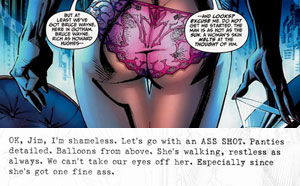
The above image, which is a panel taken from the comic All Star Batman And Robin, the Boy Wonder juxtaposed with the script written by author Frank Miller (released in the director’s edition of the comic), illustrates the way that the male gaze works in a concrete way. When Miller says, “We can’t take our eyes off her” he is speaking directly of his presumably male audience, and the follow up (“Especially since she’s got one fine ass.”) says loud and clear that her sexualized portrayal is for the pleasure of the envisioned heterosexual male viewer. In essence, Viki Vale’s character is there to reassure the readership of their hetero-masculinity while simultaneously denying Vicki any agency of her own outside of that framework. She is the quintessential watched by male watchers: the writer/director (Frank), his artist, and the presumed male audience that buys the book.
As illustrated in the above examples, the term has applications outside of the framework that Mulvey initially imagined. Although it is most easily illustrated in places where creator intent is clear (or, in Frank Miller’s case, blatantly stated), creator intent is not actually a prerequisite for a creation to fall under the male gaze. Nor does the creator and/or the audience have to be male, nor does the subject of the gaze have to be unhappy with the result. In the end, the simplest way to describe the male gaze is to return it to its roots of the female model/actress/character being looked at by the the male looker.
And, well, if you’re still confused you can go read this Dinosaur Comic about it. It gives an overview of the subject in 6 panels, placing it in the humorous context of talking dinosaurs! And everyone knows things always make better sense when they’re put into context by talking dinosaurs.

"male gaze enables women to be a commodity that helps the products to get sold"
This article is very interesting in seeing how sexual objectification is fuelled and developed by the male gaze but this quotation is the most important. If we are constantly surrounded by media that portrays women as commodities and thus objects, no wonder some boys grow up to treat women as sexual objects. The male gaze is proliferated throughout our society by the dominate male gaze in media that even women self objectify themselves. I don't think this will change until men in the industry realise the damaging power of the male gaze and until more women can enter into directorial and screen writer positions. "In 2012, women comprised 18% of all directors, executive producers, producers, writers, cinematographers, and editors working on the top 250 domestic grossing films." 18% is disgustingly low, no wonder the male gaze keeps being reinstated. Even worse only 15% of films in 2013 had a female lead, this is so damaging because we are being constantly taught to sympathise and see in a man's perspective, which would be great if female characters got equal screen time. Because of our society, men are hardly ever pushed to think about things from a woman's perspective which only contributes to sexual objectification. Is there a way to communicate this problem to men?


http://www.wmm.com/resources/film_facts.shtml
http://artsbeat.blogs.nytimes.com/2014/03/11/only-15-percent-of-top-films-in-2013-put-women-in-lead-roles-study-finds/?_php=true&_type=blogs&_r=0

Bethany gets angry AGAIN

Sexual Objectification 3: Daily Rituals to Stop

This is the third installment of a four-part series about how girls and women can navigate a culture that treats them like sex objects. (See Part 1Part 2.)
There are four damaging daily rituals of objectification culture we can immediately stop engaging in to improve our health.
1) Stop seeking random male attention. 
Most women were taught that heterosexual male attention is our Holy Grail before we were even conscious of being conscious, and its hard to reject this system of validation. But we must. We give our power away a thousand times a day when we engage in habitual body monitoring so we can be visually pleasing to others. The ways in which we seek attention for our bodies varies by sexuality, race, ethnicity and ability, but the goal too often is to attract the male gaze.
Heterosexual male attention is actually pretty easy to give up, when you think about it. First, we seek it mostly from strangers we will never see again, so it doesn’t mean anything in the grand scheme of life. Who cares what the man in the car next to you thinks of your profile? You’ll probably never see him again. Secondly, men in U.S. culture are raised to objectify women as a matter of course, so an approving gaze doesn’t mean you’re unique or special. Thirdly, male validation through the gaze alone doesn’t provide anything tangible; it’s fleeting and meaningless. Lastly, men are terrible validators of physical appearance, because so many are duped by make-up, hair coloring and styling, surgical alterations,  etc. If I want an objective evaluation of how I look, a heterosexual male stranger is one of the least reliable sources on the subject.
Suggested activity: When a man catcalls you, respond with an extended laugh and declare, “I don’t exist for you!” Be prepared for a verbally violent reaction as you are challenging his power as the Great Validator. Your gazer likely won’t even know why he becomes angry, since he’s simply following the societal script that you’ve interrupted.
2) Stop consuming damaging media.
That includes fashion, “beauty” and celebrity magazines, along with sexist televisionprograms, movies and music. Beauty magazines, in particular, give us very detailed instructions on how to hate ourselves, and most of us feel bad about our bodies immediately after reading. Similar effects are found with television and music videoviewing. If we avoid this media, we undercut the $80 billion a year Beauty-Industrial Complex that peddles dissatisfaction to sell products we really don’t need.
Suggested activity: Print out sheets that say something subversive about beauty culture, like “This magazine will make you hate your body,” and stealthily put them in front of beauty magazines at your local supermarket or corner store.
3) Stop playing the tapes.
Many of us girls and women play internal tapes on loop for most of our waking hours, constantly criticizing the way we look and chiding ourselves for not being properly pleasing in what we say and do. Like a smoker taking a drag first thing in the morning, many of us are addicted to this self-hatred, inspecting our bodies first thing as we hop out of bed to see what sleep has done to our waistline. Self-deprecating tapes like these cause my female students to speak up less in class. They cause some women to act stupid when they’re not, in order to appear submissive and therefore less threatening. These tapes are the primary way we sustain our body hatred.
Stopping the body-hatred tapes is no easy task, but keep in mind that we would be highly offended if someone else said the insulting things to us that we say to ourselves. These tapes aren’t constructive, and they don’t change anything in the physical world. They are just a mental drain.
Suggested activity: Sit with your legs sprawled and the fat popping out wherever. Walk with a wide stride and some swagger. Eat in public in a decidedly non-ladylike fashion. Burp and fart without apology. Adjust your breasts when necessary. Unapologetically take up space.
4) Stop competing with other women.
Unwritten rules require us to compete with other women for our own self-esteem. The game is simple: The prize is male attention, which we perceive as finite, so when other girls/women get attention from men we lose. This game causes many of us to reflexively see other women as natural competitors, and we feel bad when we encounter women who garner more male attention than we do. We walk into parties and see where we fit in the “pretty girl pecking order.” We secretly feel happy when our female friends gain weight. We criticize other women’s hair and clothing. We flirt with other women’s boyfriends to get attention, even if we’re not romantically interested in them.
Suggested activity: When you see a woman who triggers competitiveness, practice active love instead. Smile at her. Go out of your way to talk to her. Do whatever you can to dispel the notion that female competition is the natural order. If you see a woman who appears to embrace the male attention game, recognize the pressure that produces this and go out of your way to accept and love her.

This whole article just makes me want to smack my head against the wall, repeatedly until I create such tremors that every girl in a 100 mile radius feels it and realises that women do not deserve or pander for sexual objectification. YOU DO NOT DESERVE THIS, YOU DO NOT CAUSE THIS even if you walk out in your underwear you should still be treated like a human and not like an object. Simple. Apparently it is not simple, probably because women's magazines like this one spout this rubbish. Sexual objectification and harassment can only be avoided by discussion and education to men. Number One is the most infuriating; 1. Stop seeking random male attention. That is such a huge assumption, I dress myself for myself as do most women. My number one goal in life is not to attract a male. This first rule, assumes that women go out of their way to be objectified, because of course it makes me feel really good about myself when I am treated like a sexual object. As Laci Green would say "subjectify me baby," women want to be treated like humans, and nothing sickens me more than being told 'I would so totally fuck you.' Coincidently subjectify is marked by it's red line because it is not a real word, we have created objectify because it is such a common phenomenon. I want to live in a world where subjectify is a word, and the word objectify has been lost in the haze of time, and stained with the same shame as the word slavery.
I think is is damaging to instruct women how to 'navigate a world where they are seen as sexual objects' because this preaches acceptance and not a demand for change. It gives women platitudes and removes their power. Women should be getting angry about this but we accept too much. How can we change this?

CNN article makes me angry:

Men see bikini-clad women as objects, psychologists say

By Elizabeth Landau CNN
CHICAGO, Illinois (CNN) -- It may seem obvious that men perceive women in sexy bathing suits as objects, but now there's science to back it up.

Images of women in bikinis prompted brain responses in men associated with using tools.
New research shows that, in men, the brain areas associated with handling tools and the intention to perform actions light up when viewing images of women in bikinis.
The research was presented this week by Susan Fiske, professor of psychology at Princeton University, at the annual meeting of the American Association for the Advancement of Science.

"This is just the first study which was focused on the idea that men of a certain age view sex as a highly desirable goal, and if you present them with a provocative woman, then that will tend to prime goal-related responses," she told CNN. Although consistent with conventional wisdom, the way that men may depersonalize sexual images of women is not entirely something they control. In fact, it's a byproduct of human evolution, experts say. The first male humans had an incentive to seek fertile women as the means of spreading their genes. "They're not fully conscious responses, and so people don't know the extent to which they're being influenced," Fiske said. "It's important to recognize the effects."

The participants, 21 heterosexual male undergraduates at Princeton, took questionnaires to determine whether they harbor "benevolent" sexism, which includes the belief that a woman's place is in the home, or hostile sexism, a more adversarial viewpoint which includes the belief that women attempt to dominate men.

In the men who scored highest on hostile sexism, the part of the brain associated with analyzing another person's thoughts, feelings and intentions was inactive while viewing scantily clad women, Fiske said.
Men also remember these women's bodies better than those of fully-clothed women, Fiske said. Each image was shown for only a fraction of a second.

A supplementary study on both male and female undergraduates found that men tend to associate bikini-clad women with first-person action verbs such as I "push," "handle" and "grab" instead of the third-person forms such as she "pushes," "handles" and "grabs." They associated fully clothed women, on the other hand, with the third-person forms, indicating these women were perceived as in control of their own actions. The females who took the test did not show this effect, Fiske said. That goes along with the idea that the man looking at a woman in a bikini sees her as the object of action, Fiske said.

The findings are consistent with previous work in the field, and resonate, for example, with the abundance of female strip clubs in comparison to male strip clubs, said Dr. Charles Raison, psychiatrist and director of the Mind/Body Institute at Emory University in Atlanta, Georgia. Raison was not involved in the study.

The broader purpose of the research was to explore circumstances under which people treat one another as the means to an end, Fiske said. Past studies have also shown that when men view images of highly sexualized women, and then interact with a woman in a separate setting, they are more likely to have sexual words on their minds, she said. They are also more likely to remember the woman's physical appearance, and sit closer to her -- for instance, at a job interview.

Taken together, the research suggests that viewing certain images is not appropriate in the workplace, Fiske said. "I'm not advocating censorship, but I do think people need to know what settings should discourage the display and possession of these kinds of things," she said. Both women and men have something to learn from this line of research, Raison said. Women should be aware of how they are perceived when wearing provocative clothing, and men shouldn't let feelings of impersonal sexual longing interfere with their more personal relationships with other women, including female friends. "Many men make foolish choices because of sexual attraction," he said.
"The suggestion might be that there's some hard-wiring there that can interfere with the average man's ability to interact on deeper levels with really hot looking stranger women in bikinis," he said.

Women may also depersonalize men in certain situations, but published research on the subject has not been done, experts say. Evolutionary psychology would theorize that men view women as objects in terms of their youth and apparent fertility, while women might view men as instrumental in terms of their status and resources, Fiske said.

Another avenue to explore would be showing images of men's wives and girlfriends in bikinis, Raison said. He predicts the objectifying effect would not happen in this context.

This article is pretty horrifying but not really surprising. I think they could have saved a lot of money by instead of conducting this study, just talking to women about how they are objectified daily. All women know that when some men look at them, they do not see a whole person but ass, boobs, and legs. So the information in this article is not really groundbreaking but it is how it is written that is horrifying. The article accepts that men viewing women as objects is "hardwired" into them and therefore cannot be changed. This is so damaging in our society but is completely rampant, the idea that boys will be boys and are not responsible for their actions. This boys will be boys lie is at the core of our rape culture and victim blaming. Neither man nor woman should accept this status quo but stand against it. From my research I have seen how even the smallest most subconscious of actions has huge ripple effects across society. The female writer continues with suggesting that women should be aware of "how they are perceived when wearing provocative clothing" . In no ways does this article talk about ways to combat this problem, the writer does not even see this as a problem but instead implores to women to accommodate to men. It is just like Lily Myer's poem, 'while he waxes, she wanes' that a woman must reduce herself, her style, her identity in order to fit into the patriarchal society. It does not even consider the effect sexual objectification has on women. There is just complete acceptance and this just horrifies me because sexual objectification has become so commonplace we are accepting it.

Oppressed Majority directed by Eleonore Pourriat

This film is just fabulous in trying to show the problems women face everyday. Pourriat is brilliant in flipping commonplace sexist terms that we don't even register anymore as offensive, for example motherfuckers to fatherfuckers. I mean seriously. Genius. Pourriat says, "Sometimes men – it's not their fault – they don't imagine that women are assaulted even with words every day, with small, slight words. They can't imagine that because they are not confronted with that themselves." This was her impetus for making this film, trying to make men understand that street harassment and abuse is ingrained into our society and completely unsolicited.

Even statements like this, when flipped to the other gender, just show how insulting this is. To pass over the man as he is seen as incapable of discussing and coping with matters, is shocking and just shows how awful it is when people speak to the husband not the wife.

This smile is so beautifully forced and all women can emphasise with that as we have all been in that situation where you feel like you have to swallow the insult. Thinking about it, we should all challenge sexist assumptions like that but that takes a lot of bravery.
This scene in which the husband is forced to wear a balaclava by his wife in order not to attract attention is brilliant. This is similar to women being told to cover up in order not to be attacked. The husband seems completely emasculated, on first watching I actually mistook him for a woman. I think this is important as in order to survive in a female dominated world, he must completely eradicate his personality, his identity as a man is dictated and skewed by his society, just like women are in this patriarchy.


This character is brilliant, she is so rude just like a lot of men cat calling in the streets but because it is a woman it seems so unseemly and disgusting. 


The panic that he shows when he is locking his bike seems so real, he really captures that feeling when you know you are being watched but can't get away. 

The police room scene is incredible, I can't even count the number of situations where I have felt uncomfortable and have pulled together a cardigan or pulled down a skirt. But seeing a guy do this just shows how wrong this is, nobody should be made to feel this way because clothes are just clothes and they should make no impact on how you are treated.  The attention to detail in this film is fantastic with all the positions of power held by women, and it jars seeing all these women filling offices. Pourriat again raises questions about rape culture by having the police officer very suspicious of his story.


The wife is such an interesting character, she seems so cold and unsympathetic, she in no way understands or tries to understand what he is going through. 


The man has a breakdown, completely exhausted by the constant abuse and his wife responds with 'I can't stand your masculinist nonsense.' This is just brilliant comparison to the word feminist, so often used as an insult or stained with connotations of whiny middle aged single women stereotype. Here she uses masculinist as an insult to shut him up, showing how damaging the use of feminist as an insult is.

The ending is really interesting, as the wife walks away she is plagued by whispers of sexist abuse aimed at her. I think it ends this way to contrast back to what women face everyday, street harassment and abuse should seem as alien as it does to this woman. Also as it is unexpected for this woman her first experiences of it are scary and threatening, this emphasises how just because women have grown used to harassment we no longer find it as scary, but we should and we shouldn't have to face it.

This film is incredible in reversing the situation and highlighting what women have to deal with in a clever and poised way. Liv Siddall commented that,  "the film is so well-shot and perfectly timed it gives you goosebumps and spot-on enough to change your views on gender forever." I have to agree, as it truly captures the fear and the frustration of living in a society that favours one gender and oppresses the other. Pourriat's next project is a mockumentary about the removal of pubic hair, frankly I CANNOT WAIT

Kirsten Lepore - Move Mountain


This is Kirsten Lepore's newest contribution to the stop motion animation world and the most marked difference is the ambitious scale. The set is large and sprawling, each tree bobbing in the wind and seemingly no horizon, it is certainly impressive. However I was quite disappointed. I suppose my expectations were incredibly high, Bottle is my favourite animation ever, and so anything she made after could only seem less majestic. I love Bottle because it is subtle and sensitive but hugely bold in terms of it's subject matter. Similarly Move Mountain is similar in trying to explore the idea of overcoming obstacles and the power of determination, but I feel the characters are simply not endearing enough. The creations in Bottle were incredibly simple but had a roundness and nuanced movement that made you love them. The main characters in Move Mountain are too familiar and not surprising like the sand and snow people in Bottle. Jason Sondhi makes similar comments about it:
"While the film vaults Lepore into an upper echelon of independent stop-motion practitioners, as a storyteller it sadly fails to live up to the lofty standards of Bottle, which was, of course, a near perfect short. Similarly simplistic, Lepore conjures a mythic setting, but the character motivation is more muddled, and thus investment in her journey is lacking." I think he states it perfectly that as a story it lacks the clarity of Bottle and therefore we do not trust the characters with our sympathy.

However my own disappointments aside (and Jason's) there is a lot that is commendable about this animation.

I am fascinated with how she created these red and blue streams, the falls are just strands of plasticine but how did she create those rippled effects? I wonder why she created red and blue streams? When I see the red and blue streams it makes me think of illustrations of the heart, which have the red veins bringing in the blood and blue veins bringing the blood out. With this in mind maybe the mountain is a metaphor for the heart, sometimes it is calm, sometimes it dries up, sometimes it becomes angry and spews fire in disgust. I quite like this interpretation and thinking about it makes me appreciate this film more, the character must navigate around and through the mountain (her heart) to conquer her fears.


Again Kirsten Lepore shows her incredible use of sound, using the familiar scratching sound of flesh, this helps us feel connected to this character as although she is plasticine, she creates similar noises we recognise as human.


It is interesting to see how Lepore is using more techniques in editing, here drawing over frames to create the splashes. Maybe this is something I could experiment with?


From my feminist point of view, the male character raises a lot of questions for me. He only appears when she is in danger and shows her the cure. This troubles me but on second/third rewatch I have come to a new conclusion. I think that the female character is alone the whole time, the journey in which she meets others is the internal struggle to conquer her own fears. Therefore the male symbolises the innate belief women are bought up with that they need to be saved by a man. And at the end when she races up the mountain he vanishes because she realises she does not need a hero as she is her own heroine. The more I write about this film, the more I like it.


I think this is a nice piece of mirroring of the characters, this is her greeting, almost a prod to see if he is real. Later when she is passed out he wakes her with a prod on her hand:


I also love how this character is always eating and filling her pudgy little cheeks.


In this scene the man and woman character stumble across a party filled with a varied assortment of characters. This is pretty cool because Lepore invited other animators to contribute their characters, some I even recognise like Mikey Please. I like how Lepore brings in some humour with these characters having a little twerk, this always makes me laugh as I just imagine how many hours it would take to create this.


After the party she is left alone in the cold mist, it again creates this dreamlike atmosphere, as with her you question did that really happen? 


In both of these two frames you can see Lepore experimenting more with camera angles than in her previous work. This is something that I definitely need to play around with in my own animation. 


If we are looking at the mountain as a metaphor for her heart it is at this point where she at her weakest that the red fall starts drying up but then restarts when the male returns. 


I really want to know how she created the little fire spurts, I think it may have been through drawing over the frames.


At the end she over takes the male and loses all her friends in the mist and finally makes it to the top of the mountain alone. When she gets there she is healed, emphasising the idea that the journey itself is the healing process, the destination is not important. At the top of the mountain the mist clears, as if she has reached a point of clarity. The rising sense of impending doom which builds throughout the film suddenly dissipates, she does not appear scared that she is alone but peaceful. This again makes me think that all the other characters were simply figments and battling internal conflicts within her mind, which were conquered by the end of the film. Through close examination of this film, I actually think it is quite brilliant and I really love the message of empowerment it sends.